

Special Events & Activities


Bach 7 Preludes and Fugues
Mozart Sonata in A minor KV 310
Liszt Sonata B Minor
Leon Livshin piano
About The Program
Could we look at Baroque, Classicism, and Romanticism not as frozen chapters from art history textbooks, but rather as living, breathing phenomena — full of passion, constantly shifting? What if these aren't merely "periods," but ways of thinking, attempts to come to terms with the chaos of existence itself?
Romanticism and Baroque — they're like two neighbors who pretend not to get along, yet constantly run into each other. Let’s start with Baroque, a sort of elderly perfectionist who keeps lecturing everyone about how life should be lived: the world is vast, incomprehensible, and if you don’t organize it somehow, you’ll quickly lose your marbles. Baroque takes chaos, neatly packs it into harmonious forms, and ties it up like a beautifully wrapped gift.
But the world resists packaging — it constantly bursts out, reminding us that we’re not masters of our fate, but rather puppets. (Maybe this explains all those exaggerated gestures in baroque operas?) No matter how hard we try, chaos eventually seeps through. Perhaps that’s why Baroque tends toward monumental forms: if chaos is huge, then order has to be equally grand. Hence the toccatas, suites, preludes and of course fugues — the peak of polyphony — where chaos seems tamed, yet the soul still trembles.
Gradually, Baroque slides gently into playful yet rigid lines of Classicism, obsessed with even greater clarity, symmetry, and order. Classicism, if you like, is Baroque’s younger sibling who managed, at least temporarily, to tame chaos. Everything here is neatly structured, ranked, filed precisely on shelves. A step away from the ideal is practically considered an escape attempt — and anyone daring to step out of line (like Mozart with his Requiem or the sonata I’m planning to play) gets figuratively "shot down" without warning. Can there be something like romantic Classicism or baroque Romanticism?
And here enters our third character — Romanticism — protesting loudly against this perfect classical order. What exactly is Romanticism? Perhaps it's a cultural rebellion of the individual tired of baroque propriety and classical constraints? Is it the rebirth of the Renaissance "I," freed at last from the heavy rubble of formality, hoarsely proclaiming its right to exist? A tree tired of having its branches trimmed into elaborate shapes?
Like the baroque figure, the romantic faces chaos alone — but while the baroque hero attempts to tame and structure chaos, the romantic lives in it fully. It’s well known that he "rebelliously seeks the storm," and naturally, the storm finds him — usually hatless and wigless. The romantic doesn’t carve out a cozy corner in chaos; he amplifies it instead. With full sails he pursues his ideal, preferably eternal and unattainable.
The entire passion and pain of Romanticism lie in pursuing something clearly impossible. If the romantic hero falls in love, it’s invariably with someone he cannot possibly have: a fairy, a Beautiful Lady, or even his own sister. The built-in tragedy is essential.
While Baroque resigns itself to the drama of existence, Romanticism transforms suffering into art. The dissonance between what is, what you desire, and what you actually get creates tension that energizes the romantic hero. Romanticism thrives in eternal conflict with the world — but, weary of its predictability, turns its back on it and dives once more into chaos, as if that’s where it truly belongs. That’s why, when I play Liszt’s phenomenal sonata, I still can’t figure out: is this tragedy — or triumph?
In the end, are Baroque, Classicism, and Romanticism really about art — or actually about us? And how exactly does today's fashionable concept of Narcissism fit into all this? Isn't contemporary narcissism simply our attempt to convince ourselves (and everyone else) that our personal chaos and emptiness conceal profound harmony? Perhaps, like baroque heroes, we strive to wrap our inner turmoil in perfectly filtered selfies and carefully curated stories. Or maybe, like romantics, we eagerly chase storms just to look more impressive posing against them?
I don’t have answers (unless music counts). Perhaps there are no answers at all. Perhaps the true beauty lies hidden within the question itself.


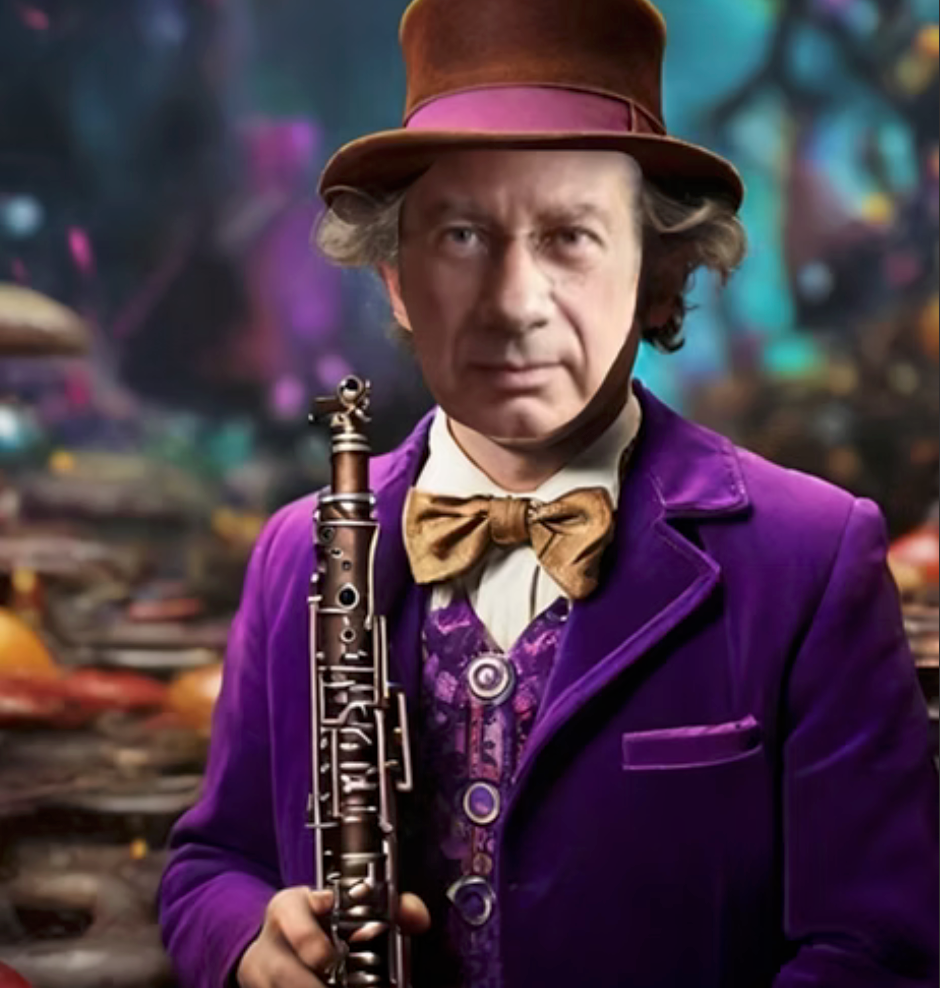

Charlie and the Composers
Composers Concordance Presents
Clarinetist Charles Neidich Performs
New Compositions in Duets with the Composers
Composers:
Lynn Bechtold, Kitty Brazelton, Dan Cooper,
Debra Kaye, Stefania de Kenessey,
Eugene W. McBride, Ginka Mizuki,
Audrey Morse, Charles Neidich,
Gene Pritkser, William Schimmel
Performers:
Charles Neidich - clarinet
Debra Kaye, Eugene W. McBride,
Stefania de Kenessey - piano
Lynn Bechtold, Audrey Morse - violin
Kitty Brazelton - voice
William Schimmel - accordion
Gene Pritsker - guitar
Dan Cooper - bass
Michiyo Suzuki - tea ceremony
Friday, June 6th, 2025, at 7pm
The Ellington Room at Manhattan Plaza
400 W 43rd St
New York, NY 10036
FREE EVENT
"We are the music makers, and we are the dreamers of dreams.”. - Roald Dahl
For Immediate Release - New York, NY - On Friday, June 6th, 2025 at 7pm at The Ellington Room at Manhattan Plaza, Composers Concordance presents a unique concert event entitled 'Charlie and the Composers.' The acclaimed clarinetist Charles Neidich performs new compositions in duets with composers Lynn Bechtold, Kitty Brazelton, Dan Cooper, Debra Kaye, Stefania de Kenessey, Eugene W. McBride, Ginka Mizuki, Audrey Morse, Charles Neidich, Gene Pritsker, and William Schimmel.
Featured on the program are Gene Pritsker's 'Bluesatins', Debra Kaye's 'Dialogues with the Distant Mountains,' and William Schimmel's 'Have Mersey on Rio!' Other highlights include Ginka Mizuki's 'Kissako' for clarinet and tea ceremony.
Charles Neidich has gained worldwide recognition as one of the most mesmerizing virtuosos on his instrument. With a tone of hypnotic beauty and a dazzling technique, Mr. Neidich has received unanimous accolades from critics and fellow musicians both in the United States and abroad; but it is his musical intelligence in scores as diverse as Mozart and Elliott Carter that have earned for Mr. Neidich a unique place among clarinetists. In the words of The New Yorker, “He’s an artist of uncommon merit -- a master of his instrument and, beyond that, an interpreter who keeps listeners hanging on each phrase.”
The concert will also be live-streamed on Composers Concordance's Facebook Page.
